Last updated: 24 November 2026. Based on RBI’s draft directions of 23 November 2026, which are open for public comment until 14 December 2026. We will update this page when RBI issues final rules.
Short answer: Money can leave your account without you sharing an OTP if a criminal controls your SIM, your phone or your login. Who carries the loss depends largely on whether the bank was negligent. RBI’s draft of 23 November 2026 widens what counts as bank negligence, including security breaches, staff or vendor collusion, missed alerts and slow complaint handling. Most of that is proposed from 1 January 2027. Report fast either way.
How money leaves without an OTP
| Method | How it works | Warning sign |
|---|---|---|
| SIM swap | A criminal gets a duplicate SIM for your number and receives your OTPs | Your phone suddenly shows “No service” |
| Malicious APK | A fake app (often sent on WhatsApp as a “bill”, “challan” or “KYC update”) reads your SMS and forwards OTPs | You installed an app from outside the Play Store |
| Screen-sharing app | A “support agent” asks you to install a remote-access app and watches you enter details | Someone asks you to install AnyDesk, TeamViewer or similar |
| Leaked credentials | Card data or logins stolen in a data breach are used online | Small “test” transactions you don’t recognise |
| QR / collect request | You are tricked into approving the payment yourself | Being asked to “scan to receive” or enter a PIN to get money |
| Insider or vendor fraud | Someone with access at the bank or its vendor misuses data | Fraud with no action on your side at all |
In the last two rows, you made no mistake at all. That is exactly where the question of who pays matters most.
Who pays today
RBI’s rules on customer liability depend on whether the fraud was due to the bank’s negligence, the customer’s negligence (such as sharing credentials), or a third-party breach, and on how quickly you report it. In June 2026 RBI updated these rules, including a one-time 85% compensation for small digital frauds from 1 January 2027. In October 2026, the Supreme Court said banks must compensate cyber fraud victims where the bank failed in due diligence.
What RBI’s new draft adds
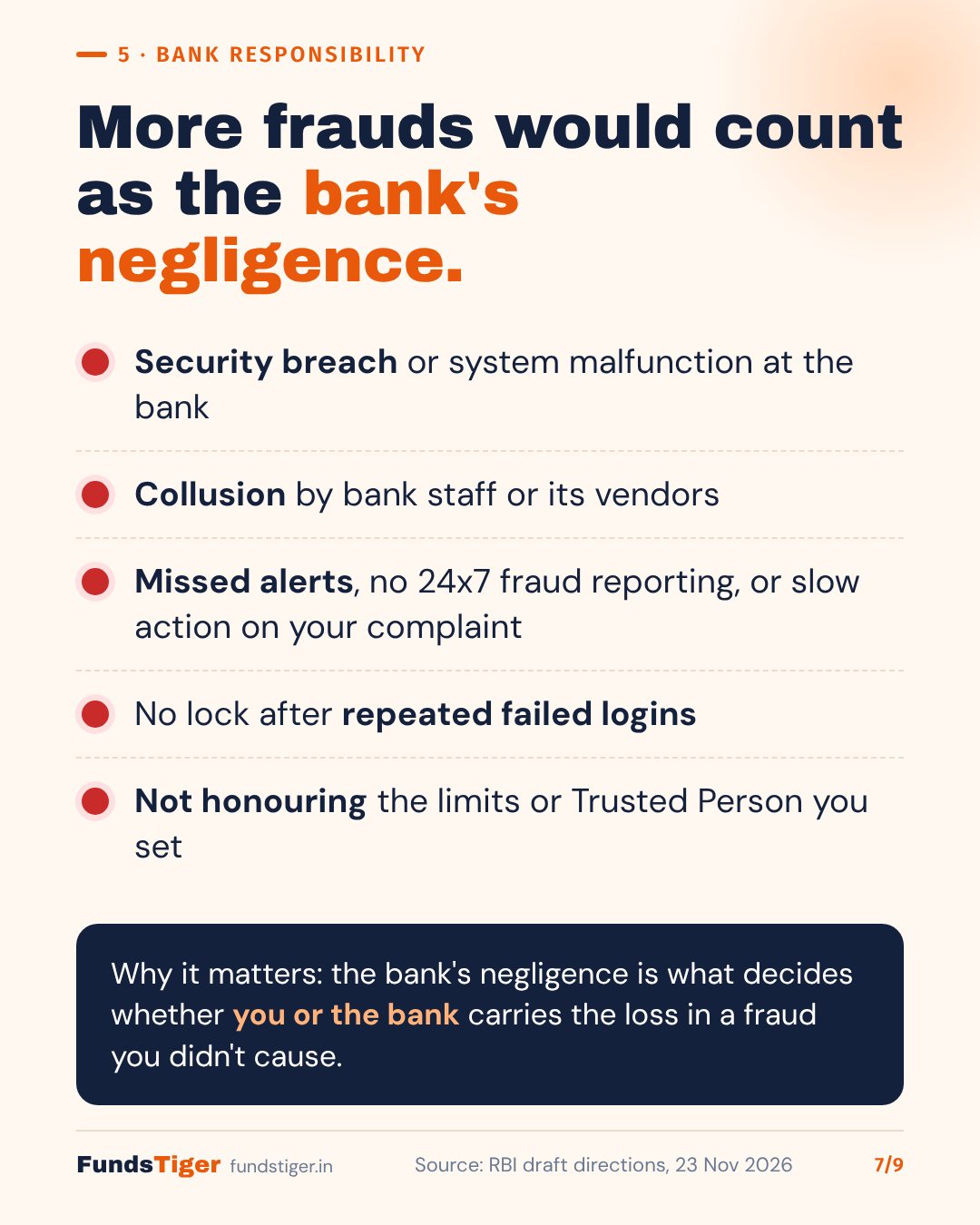
The draft replaces the definition of “negligence by a bank” with a wider one: any act or omission by the bank that results in, or contributes to, a fraudulent electronic transaction. It lists ten examples:
- Not implementing RBI’s authentication requirements for electronic transactions
- No multi-factor authentication when a beneficiary, account details or limits are changed
- Not sending a mandatory transaction alert
- No 24×7 channel to report fraud or a lost card
- Not acting promptly when you report a fraud or lost card
- Not blocking a channel or alerting you after the maximum failed login attempts
- Not providing or honouring the limits and controls you set
- Not providing or properly running the Trusted Person mechanism
- A system malfunction or security breach at the bank’s end
- Collusion or connivance by a bank employee or a third party engaged by the bank
Items 1–6, 9 and 10 are proposed to take effect from 1 January 2027. Items 7 and 8 depend on the new controls, which start from 1 July 2027.
Why this matters to you: if your money was taken through a breach at the bank, a vendor leak or an insider, or because you got no alert, the draft makes it clearer that this is the bank’s failure, not yours. Keep evidence that supports this: alert records (or their absence), complaint timestamps and call logs.
If it happens to you
- Block the card or channel in your bank app immediately, then call your bank’s fraud helpline.
- Call 1930 or report at cybercrime.gov.in.
- Write to your bank and keep every SMS, email and complaint number. Note whether you received transaction alerts.
- If the bank doesn’t resolve it within 30 days, or you’re unhappy with the reply, escalate to the RBI Ombudsman at cms.rbi.org.in.
Our first-hour guide walks through each step with the official links.
How to prevent it
- Install apps only from the Play Store or App Store, never from a link or WhatsApp file.
- If your phone loses network for no reason, call your operator from another phone at once.
- Lower your card and transfer limits so any loss is capped. See how to set your own limits today.
- Never install a screen-sharing app at a caller’s request.
- Once available, use the Stop Switch the moment you suspect anything.
Got a loan offer by SMS or WhatsApp? Check whether the lender is RBI-regulated first.
Frequently asked questions
Can money be stolen from my bank account without an OTP?
Yes. SIM swaps, malicious apps that read your SMS, screen-sharing apps, leaked card data and insider fraud can all move money without you knowingly sharing an OTP.
Will the bank refund money lost without an OTP?
It depends on the facts and how quickly you report. If the loss was due to the bank’s negligence or a breach in its systems, the bank is expected to bear it. RBI’s June 2026 rules and its November 2026 draft both strengthen customer protection. Report within hours, not days.
What counts as bank negligence under RBI’s new draft?
Any act or omission by the bank that results in or contributes to a fraudulent electronic transaction. Examples include security breaches, collusion by staff or vendors, missing alerts, no 24×7 fraud reporting, slow action on complaints, and not honouring the limits you set.
When do the new bank negligence rules apply?
Most of the expanded definition is proposed from 1 January 2027. The parts linked to customer-set limits and the Trusted Person apply from 1 July 2027. The draft is open for comment until 14 December 2026.
Sources
- RBI press release, 23 Nov 2026: Draft Amendment Directions for “Preventive Safeguards for Electronic Banking Transactions (EBTs)”
- RBI draft: Reserve Bank of India (Commercial Banks – Responsible Business Conduct) Fifth Amendment Directions, 2026
- RBI Complaint Management System (Ombudsman)
Disclosure: FundsTiger (Gatimaan Finance Advisors Pvt. Ltd.) is a loan marketplace and lending service provider for RBI-regulated lenders. Aparampaar Finance Pvt. Ltd. (Omozing), one of those lenders, is a related party of FundsTiger. This article explains a draft that RBI may change before it is final. It is general information, not legal or financial advice.