Last updated: 24 November 2026. Based on RBI’s draft directions of 23 November 2026, which are open for public comment until 14 December 2026. We will update this page when RBI issues final rules.
Short answer: On 23 November 2026, RBI proposed a Stop Switch, which the media is calling a “kill switch” for your bank account. One action would block every payment you start from your account. Alongside it come limits you set yourself, digital channels that stay off until you switch them on, a Trusted Person who must approve large transfers, and a wider definition of when a fraud is the bank’s fault. It is a draft. Comments are open until 14 December 2026, and most of it is proposed to start on 1 July 2027.
On this page: Why now · Stop Switch · Your own limits · Safer by default · Trusted Person · Bank negligence · Dates · How to comment · What to do today · FAQs
Why RBI is doing this now
Digital fraud in India has moved past the “never share your OTP” stage. Money now leaves accounts through SIM swaps, malicious APK files that read your SMS, screen-sharing apps, and “digital arrest” calls that pressure people into making the transfer themselves. In many of these cases the victim never knowingly shared an OTP.
Until now, RBI’s rules mostly decided who pays after a fraud. In June 2026 RBI tightened the rules on customer protection in fraudulent electronic banking transactions (see our explainer on the one-time 85% refund for small frauds). In April 2026 it published a discussion paper on safeguards in digital payments. This new draft is the next step: controls that work before the money moves.
RBI issued seven parallel drafts, one for each type of bank: commercial banks, small finance banks, payments banks, local area banks, regional rural banks, urban co-operative banks and rural co-operative banks. The details below come from the commercial banks draft.
1. The Stop Switch: one action to freeze outgoing payments
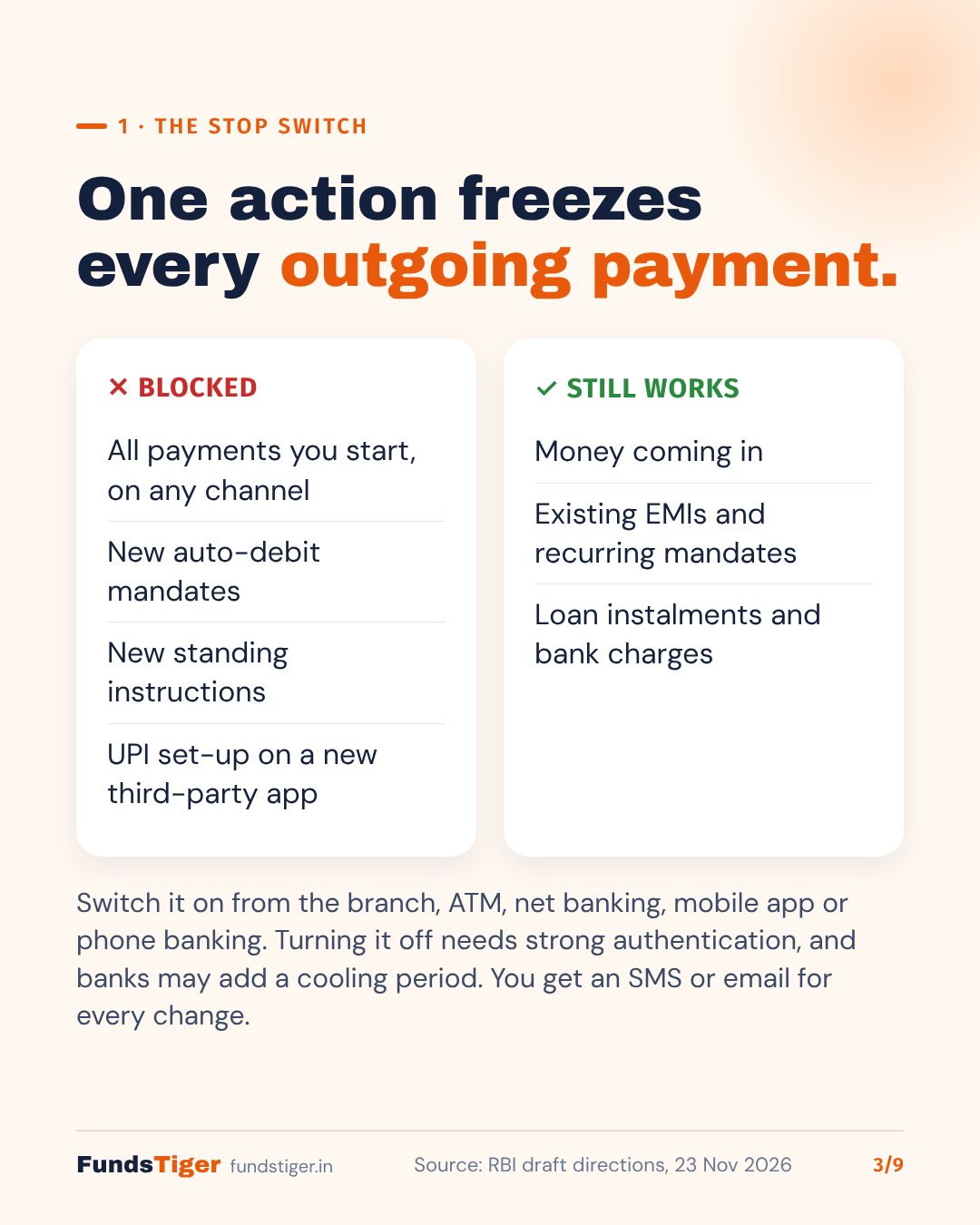
Every bank would have to offer a Stop Switch that immediately disables all customer-initiated future debits from your account. You could turn it on through the branch, ATM, internet banking, mobile banking or IVR.
| Blocked when the Stop Switch is on | Still works |
|---|---|
| Any payment or transfer you start | Money coming into your account |
| Creating new payment mandates (auto-debits) | Existing auto-debits and standing instructions, such as SIPs |
| Setting up new standing instructions | Bank debits for charges and loan EMIs |
| Registering UPI on a new third-party app | Liens already marked on the account |
Turning it off would need authentication at least as strong as was used to switch the channel on, and the bank may add a cooling period before payments resume. You would get an SMS or email for every change, and the bank would have to keep tamper-proof logs in case of a dispute.
Why it matters: in a fraud, minutes count. If you suspect your phone, SIM or app is compromised, one switch stops further loss while you call your bank and 1930. Our first-hour guide for cyber fraud covers the rest of those steps.
2. Limits you set yourself
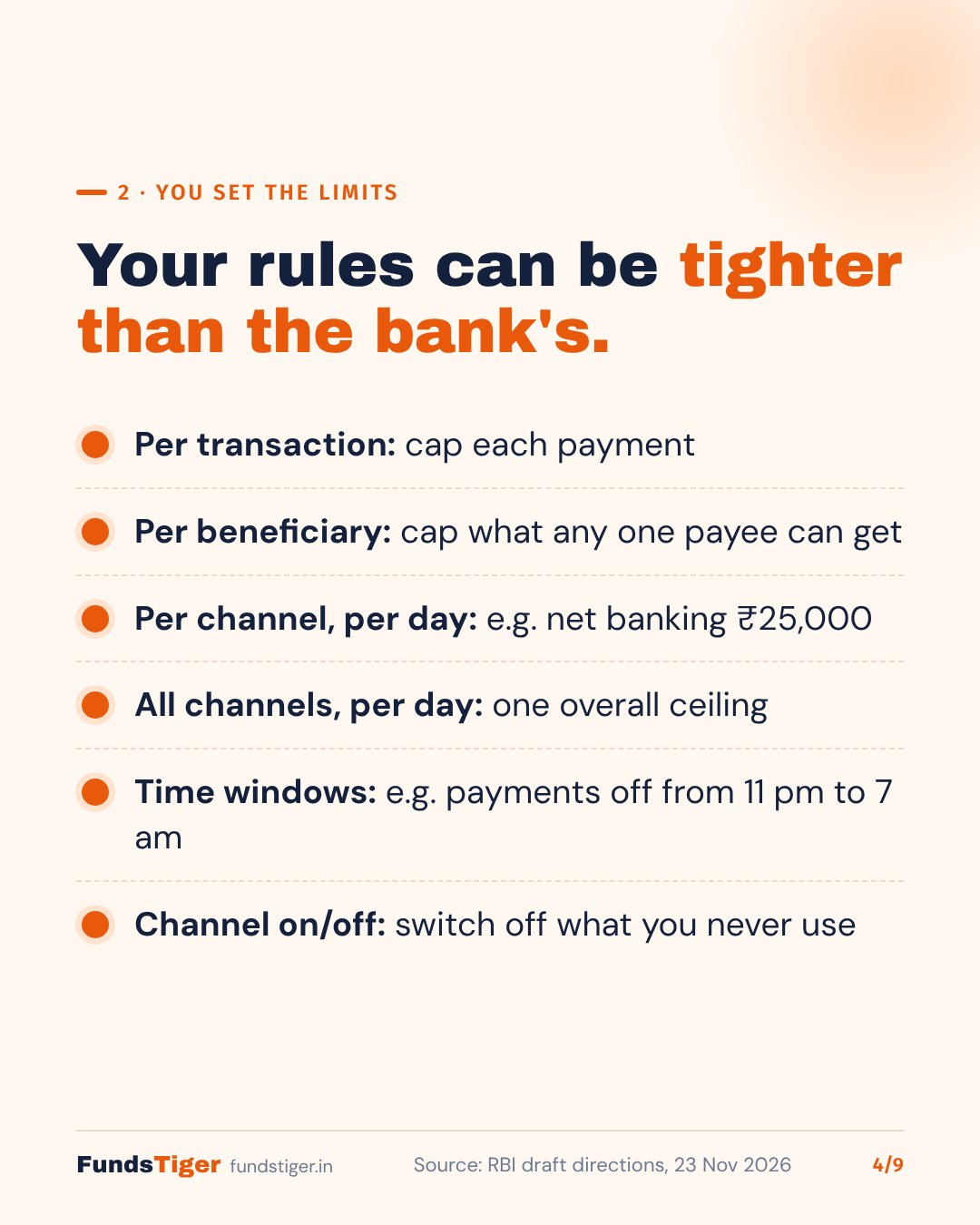
For non-card digital channels, you could set your own limits within the bank’s overall limit:
- A limit per transaction, per beneficiary, or per day for each digital channel
- An overall daily limit across all channels
- A time window when chosen channels stay off, for example overnight
- Any other control your bank chooses to offer
For cards, every cardholder could switch cards on or off and set limits separately for domestic and international use, and for ATM, shop (PoS), online and contactless payments. Many banks already offer some of these controls, and NPCI has launched a UPI Safety Switch in the BHIM app. Our step-by-step guide to setting bank, card and UPI limits today shows what you can do now.
3. Safer by default
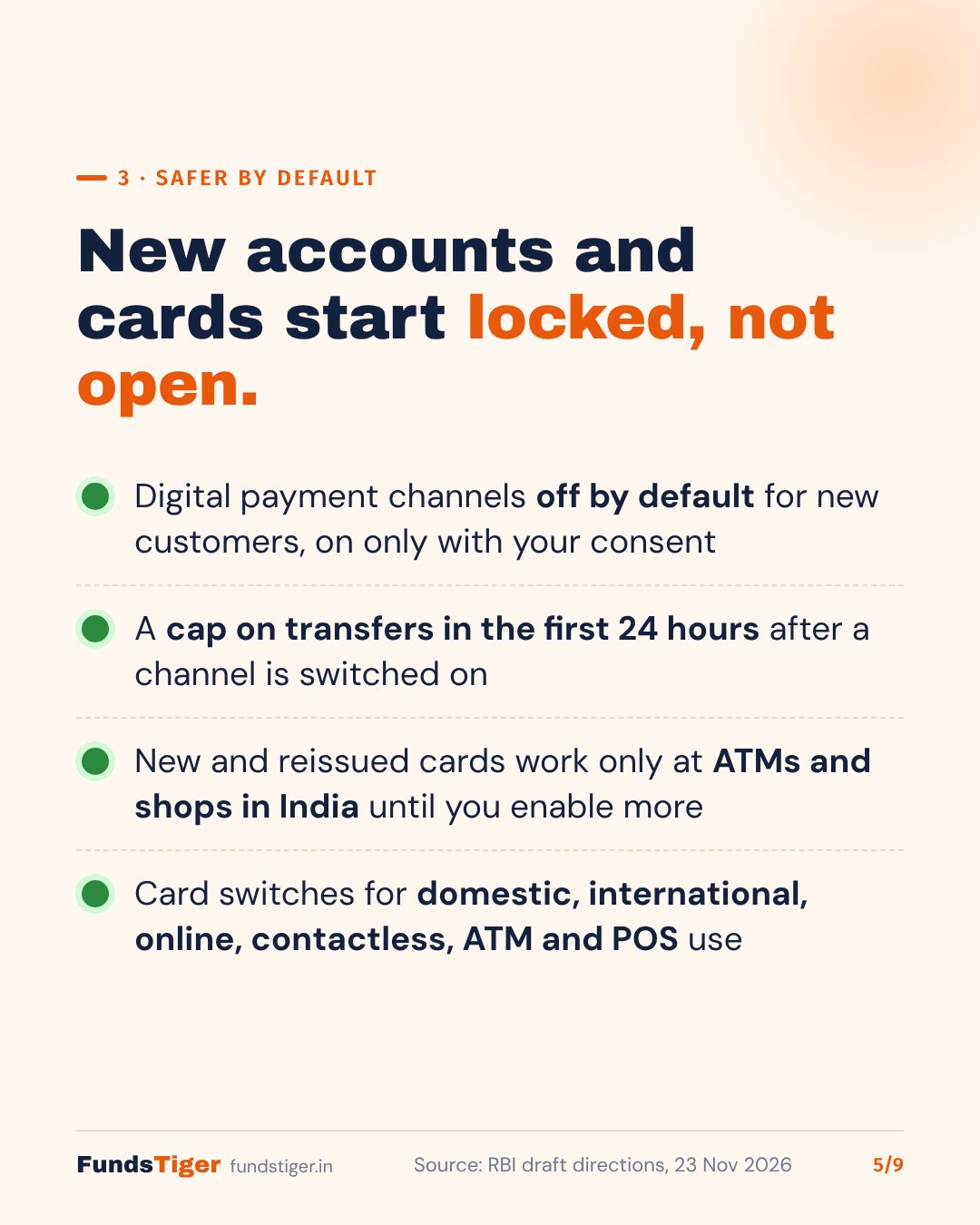
- Channels off at the start. When you open an account, all digital payment channels would stay disabled until you consent and authenticate.
- A cap on the first 24 hours. When a channel is switched on, the bank would set a ceiling on total transfers in the first 24 hours, based on its risk assessment. Fraudsters often move money right after they take over an account. Cards are not covered by this cap.
- New cards work only in India, in person. New and reissued cards, physical and virtual, would work only at ATMs and shop terminals in India until you enable more. Forex prepaid cards are the exception.
4. A Trusted Person for large transfers
You could nominate an adult as a Trusted Person and set an amount. Any electronic fund transfer above that amount would go to them for approval. They get one hour. If they reject it, or do not respond, the transfer is cancelled.
The Trusted Person cannot see your balance, operate your account, start payments, or be held liable for their decision. UPI payments, merchant payments, standing instructions, e-mandates and NACH are excluded. There is a 24-hour cooling period before it starts, and again before any change. Read our full explainer: how RBI’s Trusted Person would work, and who to choose.
5. More cases where the bank is at fault
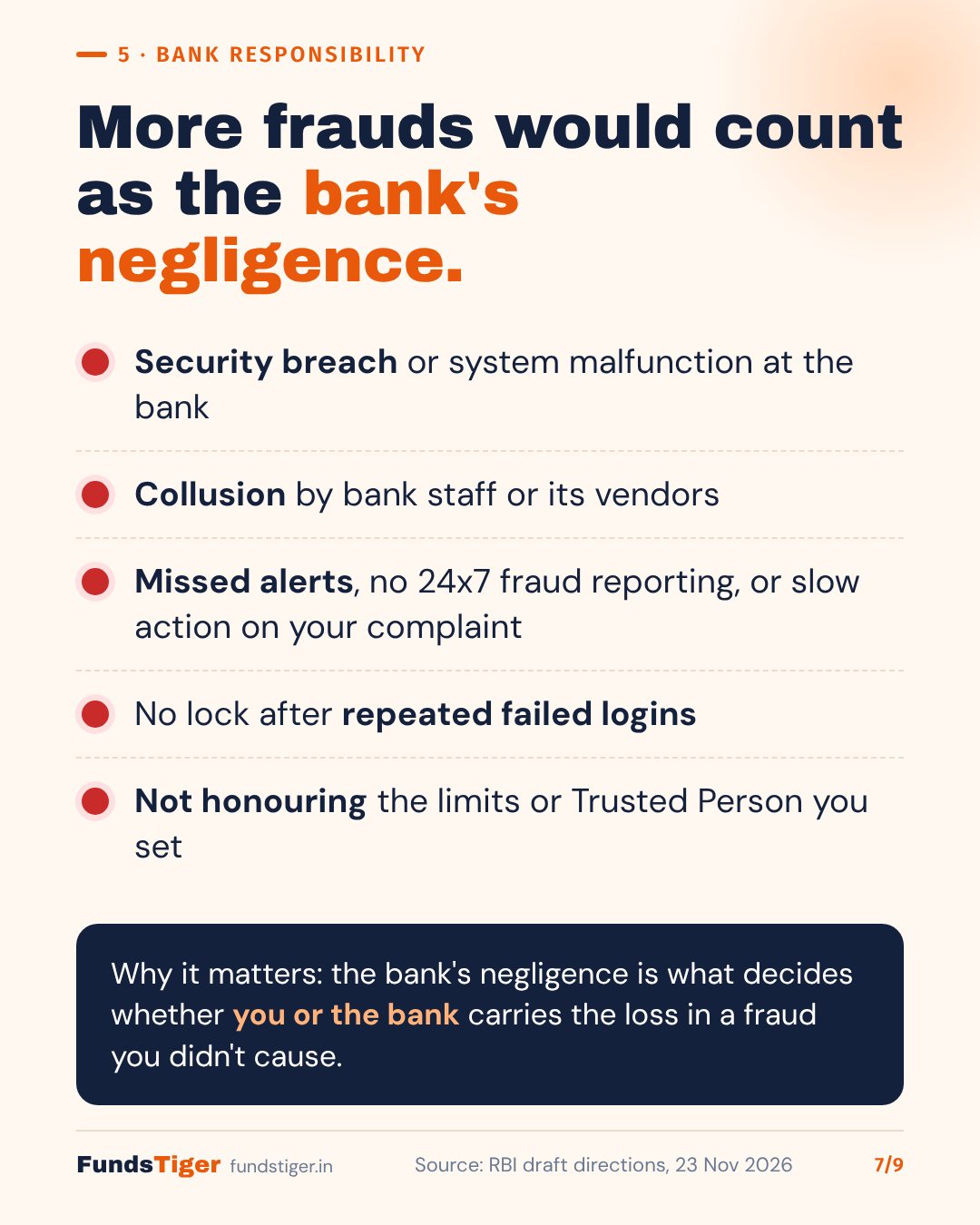
Whether a fraud counts as the bank’s negligence decides who carries the loss. The draft widens the definition to include any act or omission by the bank that results in, or contributes to, a fraudulent transaction, such as:
- Not following RBI’s authentication rules, or no multi-factor check when a beneficiary or limit is changed
- Not sending a mandatory transaction alert
- No 24×7 way to report fraud or a lost card, or slow action on your complaint
- No channel block after repeated failed logins
- Not honouring the limits or Trusted Person you set
- A system malfunction or security breach at the bank
- Collusion by a bank employee or a third party the bank engaged
Most of this list is proposed to apply from 1 January 2027. The two items tied to the new controls (your limits and the Trusted Person) follow from 1 July 2027. Our explainer money gone without an OTP: how it happens and who pays goes deeper, alongside the Supreme Court’s October 2026 order on bank compensation.
Key dates
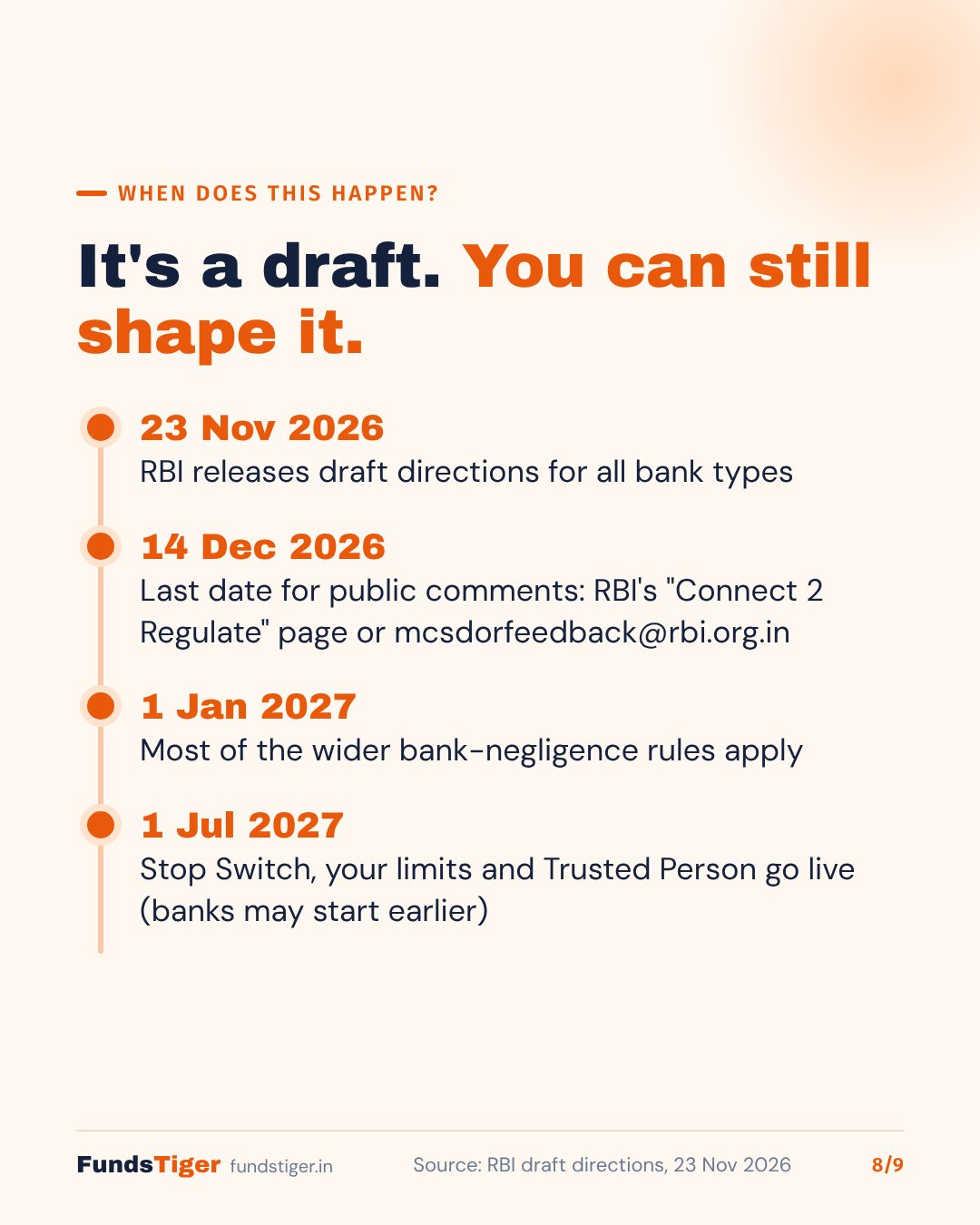
| Date | What happens |
|---|---|
| 23 Nov 2026 | RBI releases the draft directions |
| 14 Dec 2026 | Last date for public comments |
| 1 Jan 2027 | Most of the wider bank-negligence definition is proposed to take effect |
| 1 Jul 2027 | Stop Switch, customer limits, default settings and Trusted Person are proposed to take effect (banks may start earlier) |
How to send your comments to RBI
Anyone can comment: customers, banks and other stakeholders. You have two routes:
- Use the “Connect 2 Regulate” section of RBI’s website, through the link next to the draft.
- Email mcsdorfeedback@rbi.org.in with the subject “Feedback on” followed by the full name of the draft, including the type of bank, for example: Feedback on Reserve Bank of India (Commercial Banks – Responsible Business Conduct) Fifth Amendment Directions, 2026.
Points we think are worth raising:
- Make the Stop Switch one tap on the home screen of every banking app, not buried in a menu.
- Consider whether the Trusted Person should cover UPI transfers above a threshold, since many frauds now run through UPI.
- Ask banks to explain these controls in plain language and regional languages inside the app.
What you can do today
You don’t need to wait for 2027. Most banks already let you switch cards on and off, turn off international and online use, and lower limits. Take ten minutes this week:
- Switch off international and contactless use on cards you don’t use that way.
- Lower your daily card and net-banking transfer limits to what you actually need.
- Make sure SMS and email alerts are on for every debit.
- Save 1930 and your bank’s fraud helpline in your phone, and in your parents’ phones. Our 15-minute checklist for parents and grandparents covers the rest.
- If you use loan apps, check that the lender is regulated before you share any details. Use our RBI-listed loan app checker.
Full steps for SBI, HDFC Bank, ICICI Bank and others: set your own bank safety limits today.
Is a loan app real or fake? Check it against RBI’s list before you share your details.
Frequently asked questions
What is RBI’s kill switch for bank accounts?
It is the media’s name for the “Stop Switch” in RBI’s draft of 23 November 2026. When you turn it on, all payments you start from your account are blocked at once, along with new auto-debits and UPI set-up on new apps. Money still comes in, and existing EMIs and standing instructions continue.
Is the Stop Switch available now?
Not yet. It is a draft. RBI has proposed that it take effect on 1 July 2027, and banks may introduce it earlier. Many banks already let you block cards or net banking, which you can use in the meantime.
Will the Stop Switch stop my EMIs or SIPs?
No. Under the draft, existing recurring mandates and standing instructions continue, and so do bank debits for loan instalments and charges. Only new mandates and new standing instructions are blocked.
Does the Trusted Person cover UPI?
No. The draft excludes UPI payments, merchant payments, and recurring payments through standing instructions, e-mandates or NACH.
When do the new bank negligence rules start?
Most of the expanded definition of bank negligence is proposed to take effect from 1 January 2027. The parts linked to customer-set limits and the Trusted Person follow from 1 July 2027.
How can I give feedback to RBI on this draft?
Through the Connect 2 Regulate section on RBI’s website, or by email to mcsdorfeedback@rbi.org.in, on or before 14 December 2026.
Sources
- RBI press release, 23 Nov 2026: Draft Amendment Directions for “Preventive Safeguards for Electronic Banking Transactions (EBTs)”
- RBI draft: Reserve Bank of India (Commercial Banks – Responsible Business Conduct) Fifth Amendment Directions, 2026
- RBI: Connect 2 Regulate
Disclosure: FundsTiger (Gatimaan Finance Advisors Pvt. Ltd.) is a loan marketplace and lending service provider for RBI-regulated lenders. Aparampaar Finance Pvt. Ltd. (Omozing), one of those lenders, is a related party of FundsTiger. This article explains a draft that RBI may change before it is final. It is general information, not legal or financial advice.