Last updated: 24 November 2026. Based on RBI’s draft directions of 23 November 2026, which are open for public comment until 14 December 2026. We will update this page when RBI issues final rules.
Short answer: RBI’s draft of 23 November 2026 lets you nominate a Trusted Person, an adult who must approve any electronic transfer above an amount you choose. They get one hour to approve. If they say no, or don’t reply, the transfer is rejected. They can’t see your balance or touch your account. It is voluntary, it excludes UPI, and it is proposed from 1 July 2027.
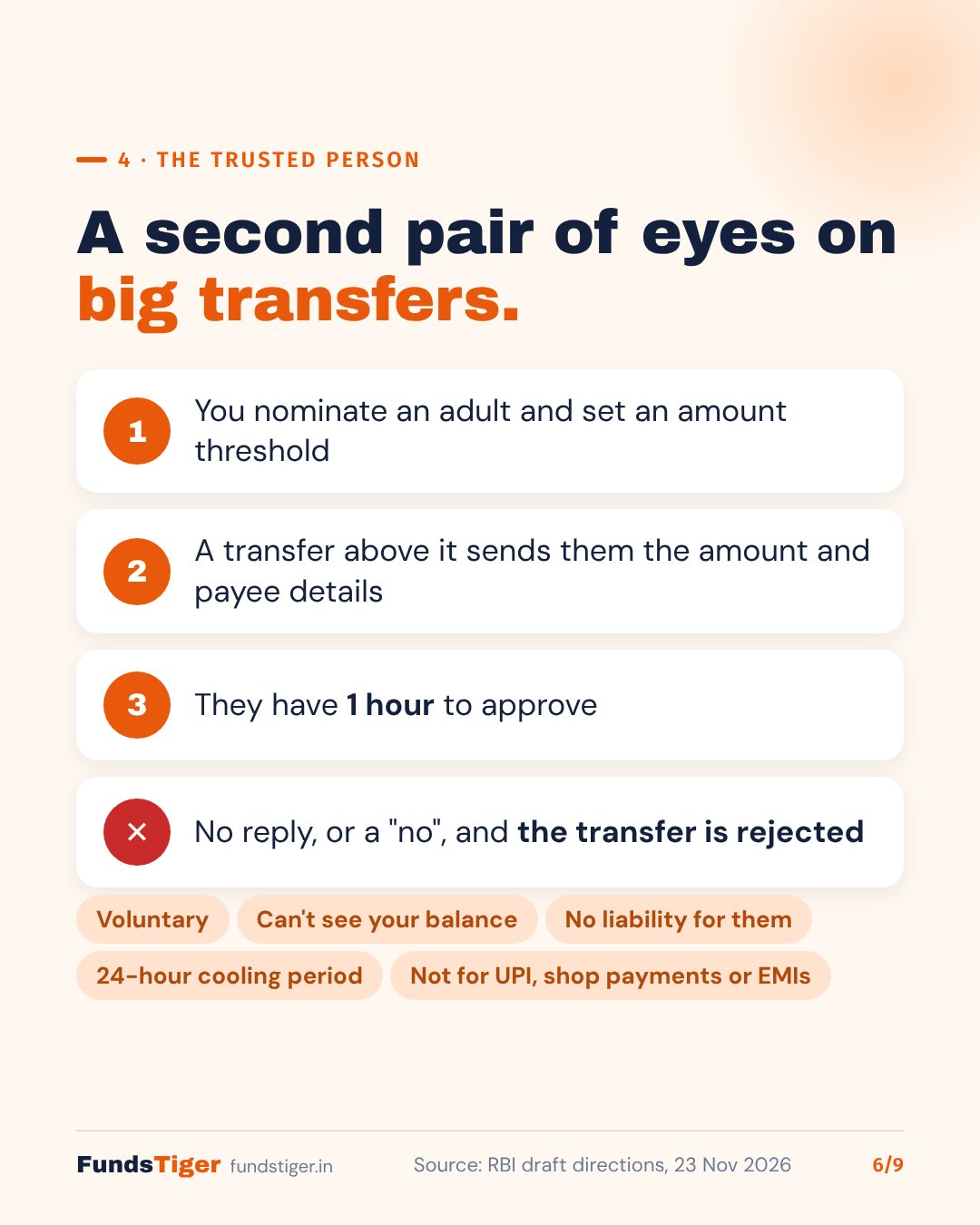
How it would work, step by step
- You and your chosen person both ask the bank to register them. The bank verifies their name, mobile number, email and an officially valid ID document. Their mobile number must be different from yours.
- You set a threshold amount.
- There is a 24-hour cooling period before it starts. Both of you are notified when it is active.
- When you start a transfer above the threshold, your Trusted Person gets the amount, the beneficiary’s details and the narration.
- They have one hour to approve. A rejection, or no reply, means the transfer is rejected.
What a Trusted Person can and can’t do
They can: approve or reject transfers above your threshold. That is all.
They can’t:
- See your balance, fixed deposits, investments or insurance details
- Operate your account, start a payment or give the bank instructions
- Act as a joint holder, nominee, mandate holder or signatory
- Be held financially liable for approving or rejecting a transfer
Their role is limited to approving transactions. It gives them no rights in your account.
What it covers, and what it doesn’t
It applies to electronic fund transfers above your threshold, whether you start them online or at a branch. It applies to individual accounts, and to joint accounts held with a survivorship clause.
Not covered: UPI payments, merchant payments through any channel, and recurring payments through standing instructions, e-mandates or NACH (so your EMIs and SIPs carry on as usual).
Changing your Trusted Person or threshold, or opting out, also has a 24-hour cooling period and needs your authentication. For customers the bank considers more vulnerable to fraud, it may ask for a branch visit or a verification call. That stops a scammer who has taken over your phone from simply switching the safeguard off.
Why this could help: the scam playbook relies on speed
Most high-value scams work by keeping the victim panicked and isolated. In a “digital arrest” scam, the caller keeps the victim on video for hours and forbids them from telling anyone. Investment and fake trading app scams push “deposit now before the window closes”. A Trusted Person adds a calm second opinion and an hour of time. That is exactly what these scripts are designed to prevent.
The gaps
- UPI is excluded. A lot of everyday fraud runs through UPI. Large one-off scams often use NEFT, RTGS or IMPS, which would be covered.
- It is voluntary, and needs both people to sign up. Those most at risk may be least likely to set it up without help.
- An hour can be inconvenient for genuine urgent payments, such as a hospital deposit. A sensible threshold helps.
Who should you choose?
Pick someone who is reachable most of the day, picks up calls from you, and will ask questions rather than approve automatically. Many families will choose an adult child for their parents, or a spouse. Avoid anyone whose phone is shared with you, since the draft requires a different mobile number. Set the threshold above your normal large payments (rent, fees, insurance) so they only hear from the bank when something is unusual.
Until the rule takes effect, you can get most of the benefit today: lower your parents’ transfer limits and make sure alerts reach a family member. Our guide to setting bank, card and UPI limits shows how, and our family fraud checklist is written to share with older relatives.
This is one part of a larger draft. Read the full picture: RBI’s Stop Switch for your bank account, explained.
Protect your family from loan scams too: check any lending app against RBI’s list.
Frequently asked questions
What is the Trusted Person mechanism in RBI’s draft?
It is an optional safeguard in RBI’s draft of 23 November 2026. You nominate an adult who must approve electronic fund transfers above an amount you set. If they reject a transfer, or don’t respond within one hour, it is rejected.
Can my Trusted Person see my bank balance?
No. The draft says the Trusted Person cannot see your balance, fixed deposits, investments or insurance details, cannot operate your account, and cannot start any transaction.
Is the Trusted Person liable if they approve a fraudulent transfer?
No. The draft says the Trusted Person carries no financial liability for approving or rejecting a transaction.
Does the Trusted Person apply to UPI payments?
No. UPI payments, merchant payments and recurring payments via standing instructions, e-mandates or NACH are excluded.
When will the Trusted Person feature start?
It is proposed from 1 July 2027, and banks may offer it earlier. The draft is open for public comment until 14 December 2026.
Sources
- RBI press release, 23 Nov 2026: Draft Amendment Directions for “Preventive Safeguards for Electronic Banking Transactions (EBTs)”
- RBI draft: Reserve Bank of India (Commercial Banks – Responsible Business Conduct) Fifth Amendment Directions, 2026
Disclosure: FundsTiger (Gatimaan Finance Advisors Pvt. Ltd.) is a loan marketplace and lending service provider for RBI-regulated lenders. Aparampaar Finance Pvt. Ltd. (Omozing), one of those lenders, is a related party of FundsTiger. This article explains a draft that RBI may change before it is final. It is general information, not legal or financial advice.